Hard Moves vs. Soft Moves
The reader of the first edition of Apocalypse World is on page 155 of the text before the term hard move comes up. Its counterpart, soft move, is never referenced.
One of the first generation of games descended from Apocalypse World is Dungeon World 1e. The reader is on page 164 before either of these terms come up:
When to Make a Move
You make a move:
- When everyone looks to you to find out what happens
- When the players give you a golden opportunity
- When they roll a 6-
Generally when the players are just looking at you to find out what happens you make a soft move, otherwise you make a hard move.
A soft move is one without immediate, irrevocable consequences. That usually means it’s something not all that bad, like revealing that there’s more treasure if they can just find a way past the golem (offer an opportunity with cost). It can also mean that it’s something bad, but they have time to avoid it, like having the goblin archers loose their arrows (show signs of an approaching threat) with a chance for them to dodge out of danger.
A soft move ignored becomes a golden opportunity for a hard move. If the players do nothing about the hail of arrows flying towards them it’s a golden opportunity to use the deal damage move.
Hard moves, on the other hand, have immediate consequences. Dealing damage is almost always a hard move, since it means a loss of HP that won’t be recovered without some action from the players.
When you have a chance to make a hard move you can opt for a soft one instead if it better fits the situation. Sometimes things just work out for the best.
Jeremy Strandberg, noted Dungeon World whisperer before publishing Stonetop, described it thusly:
I’ve never found those definitions satisfactory. The difference between them ends up being differences of degrees. You can almost always find an “immediate consequence” in whatever soft move is presented, and supposedly “hard” moves like deal damage aren’t all that bad if the damage die is low and the PC’s HP are high.
I think it’s much more useful to think of a soft move as “provoke action or raise the stakes” and a hard move as “establish badness.” There’s still overlap between soft and hard moves with these definitions, but they’re more actionable. It’s much easier to look at the scene and think “how can I provoke action or crank up tension?” than it is to look at the scene at think “how I can say something bad-but-not-too-bad or something that threatens badness but gives them a chance to escape it?
Note that most of the core moves of PbtA games don’t specify what happens on a 6-. (Some playbook moves do, as a way to minimize the downside for the player.) It’s up to the GM to decide whether to do a hard or soft move.
Postponing with Tokens
For basic moves, especially ones that come up too often (like Defy Danger in Dungeon World), I sometimes found it difficult to think of a good hard move in the heat of the moment.
That’s why I was particularly pleased to discover in Atma that, on a miss, the GM takes a token that they can spend later:
For the GM, when a player rolls 6 or less on a 2d6, they take a token. Tokens can be spent by narrating harm to a character (placing the token on that PC’s card), by buying characters and complications from the cards available to them (which vary depending on setting), or to invoke powerful moves from NPCs’ cards. In most PbtA games, the GM needs to improvise what complications develop on a 6-, but this token system is much more beginner friendly. It also seems to make failures less punishing for players, keeping the narrative from spiraling out of control as can happen with traditional PbtA games.
Talking with co-author Matthew Bishop, he mentioned this was for “gamifying the pacing of GM vs. player action.” I found this approach worked really well in play, given the card-based nature of Atma, with cards the GM could reference to decide how to spend their tokens.
Taking tokens is a physical action: the players see you taking the token, so the soft move is the impending threat that comes from accumulating these.
Postponing with Clocks
Blades in the Dark has one of the best descriptions of progress clocks, as well as relying on clocks more than most other TTRPG systems:
A progress clock is a circle divided into segments (see examples at right). Draw a progress clock when you need to track ongoing effort against an obstacle or the approach of impending trouble.
Sneaking into the constables watch tower? Make a clock to track the alert level of the patrolling guards. When the PCs suffer consequences from partial successes or missed rolls, fill in segments on the clock until the alarm is raised.
Generally, the more complex the [obstacle], the more segments in the progress clock.
…
Danger Clocks
The GM can use a clock to represent a progressive danger, like suspicion growing during a seduction, the proximity of pursuers in a chase, or the alert level of guards on patrol. In this case, when a complication occurs, the GM ticks one, two, or three segments on the clock, depending on the consequence level. When the clock is full, the danger comes to fruition—the guards hunt down the intruders, activate an alarm, release the hounds, etc.
(I love this page from the SRD so much that I incorporated it in its entirety in Fantastic Worlds, my compilation of the Dungeon World 1e syllabus and related material into book form.)
As GM you might fill in clock segments in public or behind the GM screen. I like filling them in publicly so that players are aware. On Discord, I use tokens from GM Lazarus.
A progress clock with four segments is good (an easier obstacle to overcome), while a danger clock with four segments is bad (the danger happens sooner).
Danger clocks are a way of postponing the hard move; all but the last tick are soft moves, advancing the clock. The final tick is the hard move.
See elsewhere:
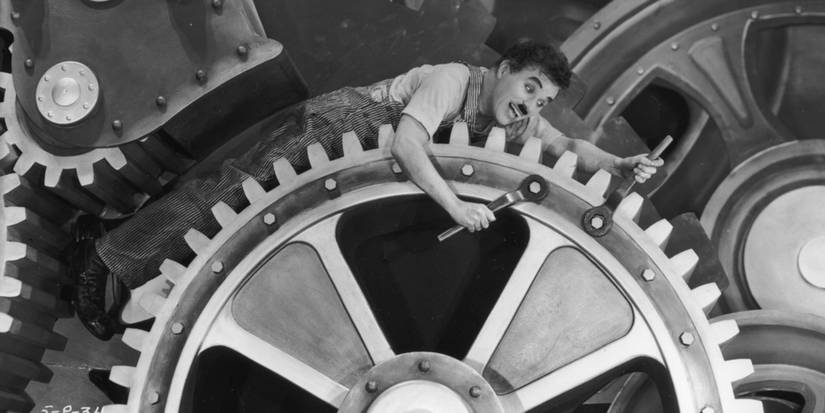
Photo credit: Charlie Chaplin in Modern Times. Public domain.

