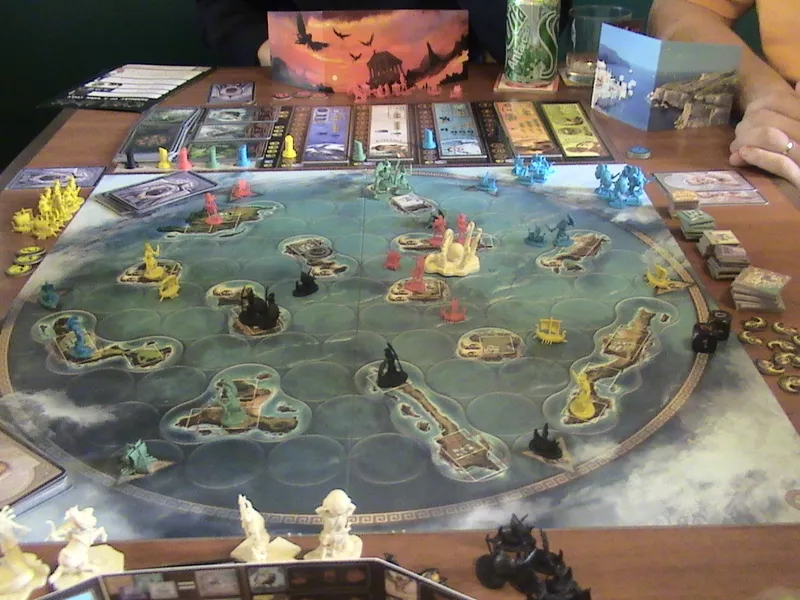
My core advice about game design is to play a simple version of the game as quickly as possible and then iterate from there. (See Agile Development for Card Games.)
A great way to do that is to take an existing game and streamline it, confident that you will further differentiate it.
For Cycladic League, I started with Cyclades by Ludovic Maublanc and Bruno Cathala. But where that is a game for 2 to 4 players, I knew this was going to be human vs. computer. I also love the eXploration phase of 4X games, and I feel like BASIC games often excelled by hiding information. I had the islands start undiscovered, hidden. Once I’d abstracted the board, I realized I needed to abstract it further: rather than place Sailors and Warriors in squares on islands, they would be abstract units, like Cyclades’ Philosophers or Priests.
The Classical Greek era is prestigious, and it made sense that the tabletop game embraced Zeus, Athena, Ares, Poseidon, and Apollo. You can see A Pantheon of Goddesses for my first iteration, for which I wanted an even split of gods and goddesses initially (instead of 4 gods and 1 goddess).
Major differences from the board game:
- Person vs. computer (2 player)
- Ships and warriors are an abstract unit, not placed on the board
- Added patrons (objectives)
- Revamped deities:
- All goddesses
- 6 instead of 4
- All 6 are available at the start rather than P-1 (player count-1)
- Actions are now free
- No bids, just turn order, with the first turn going to the player with the most priestesses
- Monsters streamlined and now random
- Tweaked economy: subsequent building on an island costs more (in the boardgame, extra income was soaked up by bidding against one another for selecting a god)
- Revamped victory points.
Photo credit: Gangster 1930, copyright 2010, some rights reserved, attribution, non-commercial

