I got the original Ticket to Ride for Christmas in 2009 (about five years late to the party), and I enjoyed it as a family game to play with the kids during the winter for the next few years. I’d hoped to convince my parents it was a fun game, but not only did they not enjoy it, my mother makes fun of it to this day (they love Scrabble, Qwirkle, and Pinochle). I’ve only played Ticket to Ride twice in the past few years, finding it to be rather long for the type of gameplay it offers. In all, I’ve played it 18 times.
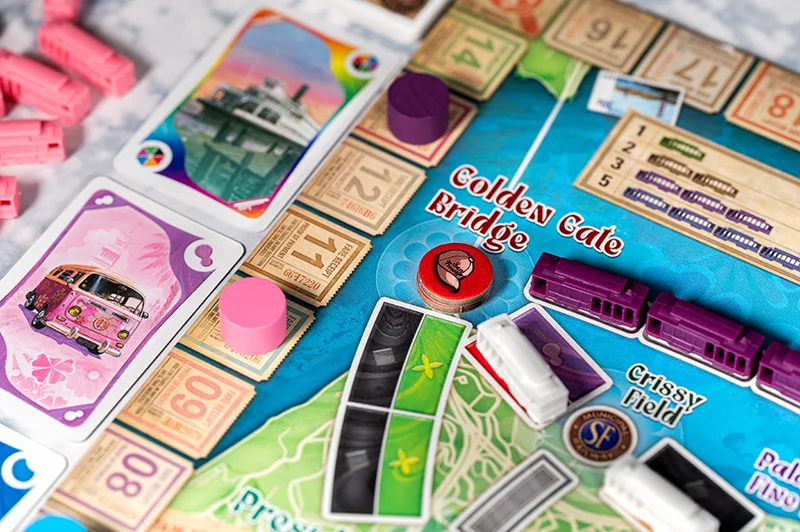
In 2019, I stumbled across Ticket to Ride: New York, the first of the city editions, at PAX East, and two of my sons and I each enjoyed it and played it twice. The next year at PAX East, a friend and I played Ticket to Ride: London once (I’ve played it twice more). I bought Ticket to Ride: San Francisco for a gaming buddy in 2023, and it’s become a staple at our table ever since—we’ve played it 25 times now!
The Ticket to Ride family is about fulfilling destination tickets that list two locations which you then need to link for points:


You collect color cards to place pieces on those colors of track, with a wildcard available.
In addition to the destination scoring, you score more points for placing more track of the same color: e.g., in San Francisco, 1 or 2 tracks is worth the corresponding number of points, but placing 3 tracks is worth 4 points, and placing 5 tracks is worth 10 points (there are no routes that need 4 tracks).
For the final bit, each game has unique scoring to differentiate it from the other games. In San Francisco, for instance, you collect tourist tokens from the edge of the map; the more tokens, the greater your score.
| Year | City / Edition | Map era | Pieces | Unique scoring | Avg BGG rating | Voters |
| 2004 | Original (USA) | 1900s | Trains | Longest continuous route bonus | 7.39 | 97,799 |
| 2018 | New York | 1960s | Taxis | Routes into tourist attractions | 6.88 | 7,682 |
| 2019 | London | 1970s | Buses | Districts fully connected | 7.05 | 5,725 |
| 2020 | Amsterdam | 1600s | Horse carts | Merchandise bonus cards | 6.91 | 1,897 |
| 2022 | San Francisco | 1960s | Cable cars | Landmark tourist tokens | 7.14 | 1,478 |
| 2023 | Berlin | 2023 | Trams + subways | Two types of pieces, route-specific | 7.24 | 678 |
| 2024 | Paris | 1920s | Buses | Blue/white/red route combos | 6.92 | 413 |
One of my dislikes about the city series in general is that trains become something else, in ways that are unthematic: taxis in New York (taxis don’t have routes) and horse-drawn carts in old Amsterdam. At least buses (London and Paris), trams and subways (Berlin), and cable cars (San Francisco) all require routes and make thematic sense.
As streamlined as they are, there’s something deeply thematic about these games for me. In fact, it’s sometimes hard for me to resist the siren call of the narrative impulse: I’ll make the narrative play rather than the optimal play. For instance, on my last turn, I should build a random rail isolated from everything else I’ve built to claim this one additional token for the added VPs. Instead, for the sake of my imaginary riders, I’d rather connect two spurs, even if it costs me the game!
The city editions work well for 2 players. As a whole, these maps are less constraining than the national maps and therefore less competitive. Ignore the comically cliché cover art and pick up one of the two highest rated city games, Ticket to Ride: San Francisco or Ticket to Ride: Berlin (next on my list to try).


Photo credits: Asmodee promotional images.

