Balancing being thematic vs. being a fun game involves making many compromises. Some examples from my game Cycladic League, a civ-light browser-based BASIC game.
Choosing Gameplay over Theme
Exploration. You start out knowing the location of just a few islands of the archipelago. This is unthematic. Fishermen probably had mapped all the prominent islands not long after they settled the archipelago. But it makes for better game play to have the islands slowly revealed. (I played dozens of times with a small archipelago and never had a game where all the islands were discovered.) This also leverages one of the strengths of computer games compared to tabletop games: lots of hidden information. (It would be logistically hard to keep parts of a map hidden from other players of a boardgame.) And I loved 4X games.
Boatyards. One of the buildings you can construct is the boatyard, which is an anachronism. In this ancient time period, boatbuilding was probably more of a communal activity done on beaches. The boardgame Cyclades, set later (in the Classical age), has ports. I thought of having a lumberyard, as most of the timber for shipbuilding came from city states like Byblos, through intermediaries; at one point, I had a shipyard. But the ability to influence naval combat was too important, so I kept the boatyard.
Unit abstraction. It’s pretty common in games to have a much lower quantity of units for ease of management and game play. Battles might involve 3 warriors attacking 1 warrior, counts off by orders of magnitude from the real world. You can’t build more than one village on an island (in fact, you can only build one of any type of building on an island), even though in the real world some islands had many villages, many workshops, etc.
Economy. Economies are always unthematic abstractions. The concession I made to theme was to rename GP (gold pieces) from Cyclades to TG (trade goods), reflecting a civilization without currency. Things that get you income are rarely the things that get you VP (Victory Points): islands and trade routes get you income but not VP, buildings that get you VP don’t produce income. (Early on mines got you both, but that meant it was always the best thing to build, because it got you 1 income and 1 VP. As a late change, I removed them from the VP calculation.)
Getting the economy for a game balanced often takes experimentation. In Cyclades, you bid for which deity’s actions you want to use. Bidding is a powerful way to fix excess cash sloshing around a game economy, because players outbid one another, burning up that cash. I needed something that increased in cost, since I didn’t have bidding. I finally settled on having the price of a building equal 3 TG plus a surcharge for every building already on that island: 3 TG for the first, 4 TG for the second, 5 TG for the third. This fixed the economy and provided the added benefit of encouraging you to build on multiple islands (which are harder to defend) and encouraging you to explore to find new islands.
Choosing Theme Over Gameplay
Mythological Creatures
In Cyclades, activating any god but Apollo lets you draft a creature to use its ability, if you pay its cost (2, 3, or 4 GP, minus a discount for the Temples you’ve built). Hey, I choose Cyclops, now I can… remove one of my buildings and replace it with a different type? Doesn’t seem very Cyclopean. Most of the creatures’ abilities aren’t very thematic: the Fates earn you revenue, the Griffon steals half the GP of another player, the Siren lets you swap an opposing ship for one of your own, etc.
I changed this in Cycladic League to building a Shrine protects you from the sudden attack of a random monster, who strikes your opponent. You have less control over what happens, less strategy, but here I prioritized the Ancient Greek theme of the unknowableness of the whims of the gods and demigods and monsters.
Combat
Combat was pretty streamlined initially. In the Cyclades boardgame, each player rolls a die and adds the number of troops or fleets they have (the dice have the faces 0, 1, 1, 2, 2, 3). The loser removes one unit. If neither retreats or is defeated, combat continues.
I started with something similar, but over time I made combat more and more thematic, but you don’t play it. You order an attack, then the computer resolves all the possibilities, in the style of 1970s BASIC games. Did all your warriors survive the crossing? (The more sailors, the more likely this is.) Did they land unopposed? (The bigger the island, the more likely this is.) What is built on the island and how does it aid the defense? (Walls, watchtowers, etc.) Do you lose warriors to disease? (The more fishers you have, the less likely this is.) How long does the siege last?
I probably wrote far too much code for this, including random wording for common options.
When Theme is Free
Sometimes theme won’t influence game play.
For instance, I moved workshops to be closer to quarries on the islands, representing archeological finds (smelters and metal working were found outside settlements). As this is just a graphic representing game state, there was no tradeoff.
I changed the names of the Classical gods to earlier goddesses, reflecting the earlier stage of history. The name change alone didn’t need to affect gameplay (though I tweaked gameplay as I changed the pantheon).
So those are the compromises of theme vs. gameplay that I made. You can see for yourself if I made the right choices by playing the game in your browser on Itch.io.
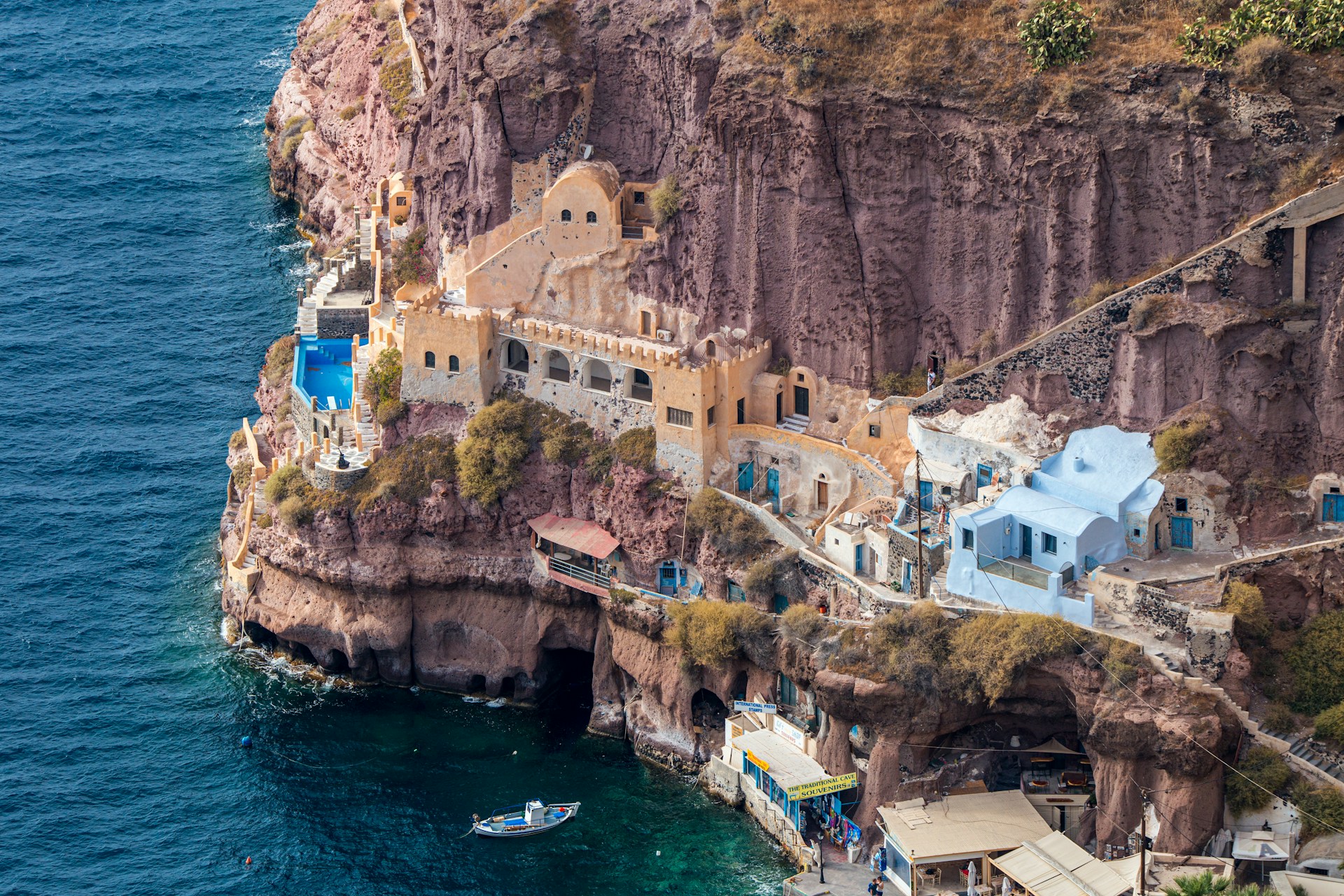
Photo credit: Santorini by Arnaud Mariat for Unsplash+.

