I bounced off podcasts when they were first being promoted by Dave Winer back in the early 2000s. I just preferred to read weblogs, as they were called then.
But one of my best friends suggested 60 Songs That Explain the ’90s, a celebration of 1990s music by Rob Harvilla, and I really enjoyed it. And then I was directed to Bandsplain and A History of Rock Music in Five Hundred Songs. Because these three podcasts are all discussing music, they play snippets of the songs they are discussing; that’s not something you can appreciate just from reading a blog.
I’ve now listened to the first 38 episodes of A History of Rock Music by Andrew Hickey, over about eight months. These aren’t just histories of a song, but broader histories that might be epitomized by the background behind the song, especially the evolution and collision of different music genres and the constant exploitation of African American musicians. Each episode is extremely well researched, using primary sources and secondary sources from the era.
Some episodes that stood out to me from the first 30.
Episode 1: “Flying Home” by the Benny Goodman Sextet:
We have to start somewhere, of course, and there’s no demarcation line for what is and isn’t rock and roll, so we’re starting well before rock and roll itself, in 1939. We’re starting, in fact, with swing.
Episode 2: “Roll ‘Em Pete” by Big Joe Turner and Pete Johnson – How strikes changed popular music.
Episode 3: “Ida Red” by Bob Wills and his Texas Playboys – Nice bit on the origins of Country & Western music.
Episode 16: “Crazy Man Crazy” by Bill Haley and the Comets – Lots of different things that surprised me here, especially the reason for the staying power of 1950s music compared to its forerunners:
Indeed a lot of the musicians’ strikes of the 1940s were, in part, about the issue of playing records on the radio. But eventually, the record labels — especially the ones, like RCA and Columbia, which were also radio network owners — realised that being played on the radio was great advertising for their records, and stopped fighting it.
And at the same time, there was a massive expansion in radio stations — and a drop in advertising money. After the war, restrictions on broadcasting were lifted, and within four years there were more than twice as many radio stations as there had been in 1946. But at the same time, the networks were no longer making as much money from advertising, which started going to TV instead. The solution was to go for cheap, local, programming — and there was little programming that was cheaper than getting a man to sit in the studio and play records.
And in 1948 and 49, Columbia and RCA introduced “high fidelity” records — the 33RPM album from Columbia, and the 45RPM single from RCA. These didn’t have the problems that 78s had, of poor sound quality and quick degradation, and so the final barrier to radio stations becoming devoted to recorded music was lifted.
This is, incidentally, why the earlier musicians we’ve talked about in this series are largely forgotten compared to musicians from even a few years later — their records came out on 78s. Radio stations threw out all their old 78s when they could start playing 45s, and so you’d never hear a Wynonie Harris or Louis Jordan played even as a golden oldie, because the radio stations didn’t have those records any more. They disappeared from the cultural memory, in a way the fifties acts didn’t.
Episode 21: “Rock Island Line” by Lonnie Donegan – My dad loved the skiffle music epitomized by Donegan, and I grew up listening to Donegan’s songs. Weird trivia fact:
In his version, the line runs down to New Orleans, which is not where the real-life Rock Island Line runs — Billy Bragg suggests in his excellent book on skiffle that this was a mishearing by Donegan of “Mule-ine”, from one of Lead Belly’s recordings — and instead of having to wait “in the hole” — wait at the side while another train goes past, the driver lies in order to avoid paying a toll (which wasn’t a feature on American railways).
Amazingly, Donegan’s version of the song’s intro became the standard, even for American musicians who presumably had some idea of American geography or the workings of American railways.
Episode 26: “Ain’t That A Shame” by Fats Domino – Also the story of how white cover versions plundered Black music:
As with all Black hits at this time, there was a terrible white cover, in this case by Pat Boone. Boone’s cover version came out almost before Domino’s did…
Randle would regularly send copies of new R&B records to white record executives he knew, and it was because of Randle that the Crew Cuts and the Diamonds, among others, first heard the Black recordings whose style they stole. In this case, he sent his acetate copy of “Ain’t That A Shame” to Randy Wood, the owner of Dot Records, a label set up specifically to record white cover versions of Black records.
Randle was an odd case, in this respect, because he *was* someone who truly loved rhythm and blues, and Black music, and would play it regularly on his show — early on, he had actually been fired from one of his first radio jobs for playing a Sister Rosetta Tharpe record, though he was soon rehired. But he seems to have truly bought into the idea that the white cover versions of Black records did help the Black performers.
There are very few examples of how little that was the case more blatant than that of Boone, a man whose attitude is best summed up by the fact that when he recorded his version, he tried to change the lyrics to “Isn’t That A Shame” because he thought “Ain’t” ungrammatical.
Boone would later go on to commit similar atrocities against “Tutti Frutti”, among other records.
Episode 27: “Tweedle Dee” by LaVern Baker — More legal maneuvering to limit Black intellectual property:
We talked a while back about how the copyright law in the 1950s didn’t protect arrangements, and how that disproportionately affected Black artists. But that doesn’t mean that the Black artists didn’t fight back. Today we’re going to talk about LaVern Baker, who led the fight for Black artists’ rights in the 1950s. But she was also one of the most successful female R&B artists of the fifties and would deserve recognition even had she never been a campaigner.
Episode 29: “Maybellene” by Chuck Berry – The music charts have long been segregated:
Genre labels have always been about race, and about policing racial boundaries in the US, since the very beginning. Remember that when Billboard started the R&B charts they were called the “race music” charts. You had the race music charts for Black people, the country charts for lower-class whites, and the pop charts for the respectable white people. That was the demarcation, and that still is the demarcation.
But people will always want to push against those constraints. And in the 1950s, just like today, there were Black people who wanted to make country music. But in the 1950s, unlike today, there was a term for the music those people were making. It was called rock and roll. For about a decade, from roughly 1955 through 1965, “rock and roll” became a term for the music which disregarded those racial boundaries. And since then there has been a slow but sure historical revisionism. The lines of rock and roll expand to let in any white man, but they constrict to push out the women and Black men who were already there. But there’s one they haven’t yet been able to push out, because this particular Black man playing country music was more or less the embodiment of rock and roll.
Episode 30: “Bo Diddley” by Bo Diddley:
In general, Black musical culture in the USA has emphasised different aspects of musical invention than white culture has. While white American musical culture — particularly *rich* white musical culture — has stressed inventive melodies and harmonic movement — think of, say, Burt Bacharach or George Gershwin — it has not historically stressed rhythmic invention. On the other hand, Black musical culture has stressed that above everything else — you’ll notice that all the rhythmic innovations we’ve talked about in this series so far, like boogie woogie, and the backbeat, and the tresillo rhythm, all came from Black musicians.
That’s not, of course, to say that Black musicians can’t be melodically inventive or white musicians rhythmically — I’m not here saying “Black people have a great sense of rhythm” or any of that racist nonsense. I’m just talking about the way that different cultures have prioritised different things.
But this means that when Black musicians have produced innovative work, it’s not been possible for them to have any intellectual property ownership in the result. You can’t steal a melody by Bacharach, but anyone can play a song with a boogie beat, or a shuffle, or a tresillo… or with the Bo Diddley beat.
One of the reasons I’ve not listened to more episodes of this and the other music podcasts is because they often inspire me to listen to the artists covered, which I like to do before moving on to the next artist. (60 Songs That Explain the 90s inspired me to listen to the entire Depeche Mode discography, for instance.)
At this point, the Five Hundred in the title A History of Rock Music in Five Hundred Songs should be considered aspirational. As of this writing, the author has covered 183 songs in 8 years; it will be 21 years before he could finish, if he kept up his historic pace. You can join me in supporting his Patreon. While it may be forever incomplete, the podcast will stand the test of time already for its telling of the history of rock music from 1939 to 1969.
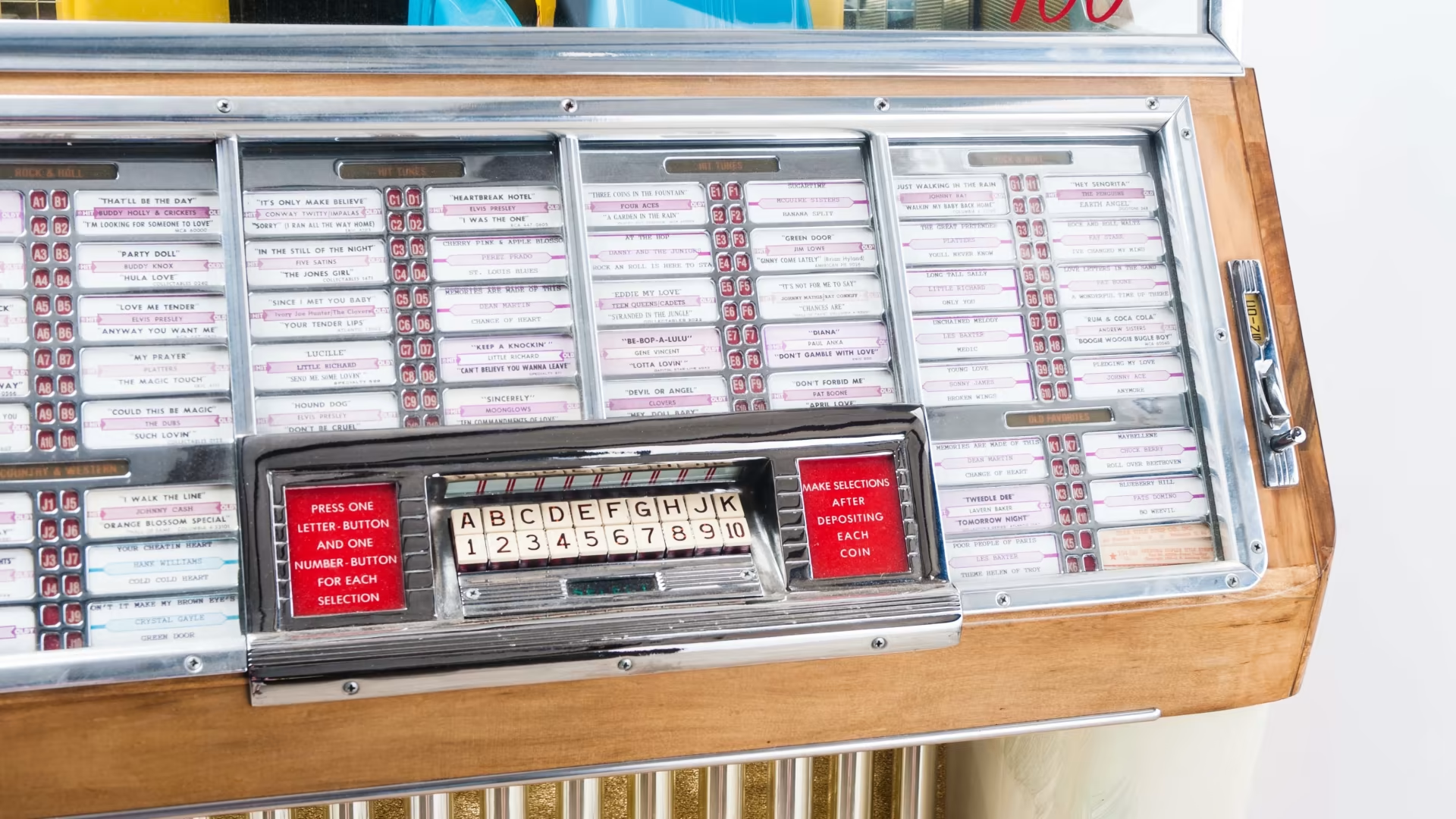
Photo credit: 1952 Seeburg jukebox, Mecum Auctions.

