Some Esperanto words can be parsed into roots and affixes in multiple ways.
- fiaskas means “to totally fail; to be a fiasco” but I parsed it as fi+ask+as as “to corrupt with spores” (a horror motif?).
- lekanto means “daisy” but when I first encountered it I parsed it as lek+ant+o, “one who licks”!
- okulo means “eye” but despite learning it I later misparsed it as ok-ulo, “eighth person” (see triulo, “third person”)
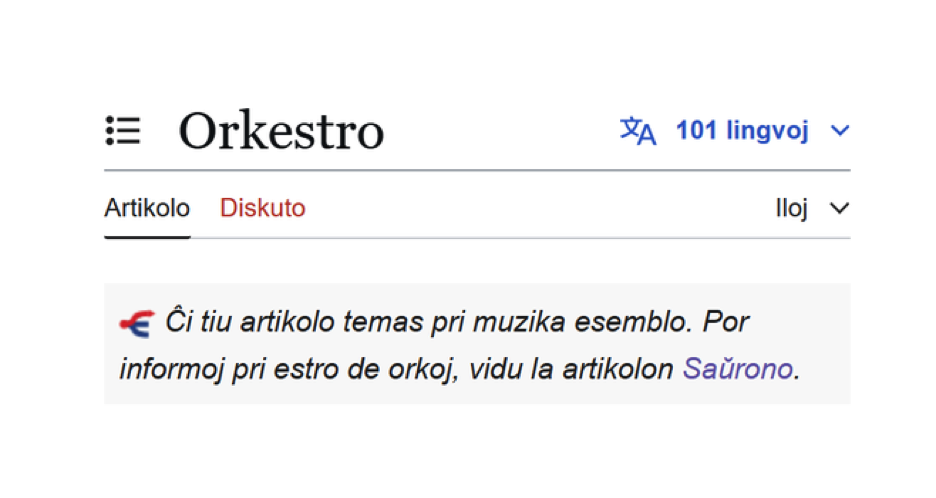
- orkestro is a root (“orchestra”) humorously misparsed as ork+estro, “orc boss” as a nickname for Sauron
- ŝatokupo is ŝat+okupo (favorite occupation=hobby) but I misparsed it as ŝato+kupo, “favorite cup”
- tegmento is a root (meaning “roof”) that I misparsed as tego+mento, “lining mint.”
The phenomenon of in-timo is when words are borrowed into Esperanto but rewriting –in– as –en– so they are not misparsed as feminine forms: e.g., delfeno instead of delfino, from Delphinidae, for “dolphin.”
Tomaso Alexander wrote in his newsletter:
Sometimes when we see a compound word in Esperanto, we just don’t know where to break it down.
Elklasĉambriĝis could be divided a number of different ways… I can imagine that “elk” looks like a root. (It isn’t.) And “las” looks like a root. (It is.) Ĉamo and briĝo are real Esperanto words.In this case, we can see that this word follows another very common pattern in Esperanto:
el___iĝi = to go out of ____
el___igi = to take out of ___
en___iĝi = to go into ____
en___igi = to put into ____If you learn this pattern, it will help you recognize a lot of words – including el-klasĉambr-iĝis (which is immediately recognizable to an experienced speaker even without context).
A few general tips
Beyond just practicing, how can we get better at seeing how to divide compound words? The good news is that there often is.Context
Even if you don’t know the common patterns that I listed above, if you see a sentence like: Tang Wenzhu tuj elklasĉambriĝis kaj kuregis al la dormĉambro. You know they’re talking about rooms. You might also notice, since her Panjo had just arrived from far away, that she might be a young person of school age. My sense (from tracking down the text in question) is that she’s at a boarding school. That might help your brain see words like “class” and “room”.Consonant clusters
If you see “klasĉambr” – you might notice the consonant cluster “sĉ“. This is very rare, and to my knowledge it’s only found in one root (disĉiplo) and so, this like this will usually indicate a division between roots.Practice practice practice
Finally, the more roots you know, the more your brain will be able to quickly go through the options. KLA is not a root. KLAS is. AMBR could be a root (but isn’t.) And so on.
Helloyanis has written a handy utility to parse Esperanto words, though it is not perfect.

The problem is not easy to solve, and the utility would probably need to suggest multiple potential segmentations for some words.
Only a few auxlangs, such as Lojban, make sure that any word can be unambiguously parsed into its constituent morphemes.
See also: Esperanto Homographs, for a discussion of identical words with different etymologies and meanings.
Photo credit: A screenshot of the header of the Esperanto Wikipedia Orkestro article.


You must be logged in to post a comment.